



How Are the Gut and the Immune System Connected?
We recently read an interesting article from UCLA Health about the connection between the gut and the immune system.
What caught our attention was how clearly the article describes the gut as much more than the place where food is broken down. It is also home to a vast community of microorganisms that continuously interact with the body and the immune system.
It made us think further: What does the food we eat actually have to do with our immune system?
Read the article from UCLA Health

The gut is more than a digestive organ
When we talk about the “gut” in everyday language, we often mean the entire digestive system. In this context, however, it is mainly the intestines that are of interest.
Every day, food, microorganisms and many other substances pass through the gut. The body needs to absorb the nutrients it requires while protecting itself from things that may be harmful.
The intestinal lining is therefore not simply a surface for absorbing nutrients. It is also an important barrier and a place where immune cells, the body’s own cells and gut microorganisms meet.
That is one reason why the gut and the immune system are so closely connected.
The microbiome is affected by what we eat
The gut is home to a large number of bacteria, fungi and other microorganisms. Together, they are known as the gut microbiota. Their collective genes and functions are often described as the gut microbiome.
Which microorganisms live there and how they function are influenced by many factors, including what we eat.
UCLA Health particularly highlights the importance of a varied diet containing plenty of fibre-rich plant foods. Different foods contain different types of carbohydrates and fibre, which in turn contribute to a more varied environment in the gut.
This does not mean that one particular food creates a “good” microbiome. What appears to matter more is variety and our dietary habits over time.
Some of our food also feeds the microbiome
Most of the food we eat is broken down and absorbed in the small intestine. But not everything follows that route.
Certain fibres and other carbohydrates continue into the large intestine. There, they can be used by the microorganisms that live in the gut.
It is a fascinating thought: The food we eat does not only provide nourishment for us, but also for the ecosystem of microorganisms we carry with us.
When these microorganisms ferment such substances, they produce various compounds that can interact with the cells of the gut and the rest of the body.
Not all fibre is the same
We often talk about fibre as though it were one single thing. In reality, there are many different types of fibre with different properties.
Vegetables, fruit, berries, pulses, whole grains, seeds and root vegetables all provide different types of fibre. Variety therefore appears to be a useful guiding principle: Different foods give different microorganisms something to work with.
This does not mean that every meal has to be perfect. Regularly varying the plant foods you eat is a more realistic starting point.
Resistant starch is also interesting
Reading the article naturally made us think about resistant starch, as this is an area we have spent a great deal of time exploring at GO100.
Resistant starch is a type of starch that is not fully broken down in the small intestine. Some of it can therefore continue into the large intestine, where it may be used by the microorganisms living there.
Resistant starch is found in foods including pulses, unripe bananas, raw potato starch and certain starchy foods that have been cooked and then cooled.
As with other fermentable carbohydrates, it can be sensible to increase the amount gradually. A rapid change may cause more gas or temporary digestive discomfort in some people.
Is a “stronger” immune system always better?
The expression “boosting the immune system” is widely used. It sounds simple and positive, but it is not a completely accurate description of how the immune system works.
The immune system should not simply react as strongly as possible. It needs to respond to the right things, at the right time, and then calm the response when it is no longer needed.
It may therefore be better to talk about giving the immune system good conditions in which to function normally.
A varied diet can be part of that. But this does not mean that one food, one type of fibre or one product can make us immune to infections or guarantee that we remain healthy.
What did we take away from the article?
The main thing we took away was not a single piece of dietary advice.
It was the reminder that the gut is part of a much bigger picture.
What we eat does not only affect how full we feel or how much energy we receive. Some of our food also becomes nourishment for the microorganisms in the gut, and these microorganisms are in constant interaction with the body.
A few simple principles therefore seem like a good place to begin:
- Eat a wide variety of plant foods.
- Vary your sources of fibre.
- Increase your fibre intake gradually.
- Look at your overall diet rather than individual “super ingredients”.
- Choose habits that are realistic enough to maintain.
It does not have to be more complicated than that.
The gut is part of the bigger picture
We find the connection between the gut, the microbiome and the immune system fascinating, not least because the research is still developing.
There is still a great deal we do not know. But one thing is clear: The gut does not work in isolation from the rest of the body.
That is also one of the reasons why we at GO100 believe the gut deserves more attention. Not only when something feels wrong, but as part of how we feel and function every day.
Frequently Asked Questions About the Gut and the Immune System
How are the gut and the immune system connected?
Many immune cells are found in and around the gut. The intestinal lining, microorganisms and immune system are in constant communication. The gut also acts as a barrier between the body and substances entering through food and the surrounding environment.
Is 70% of the immune system located in the gut?
The claim that around 70% of the immune system is located in the gut is often repeated, including by UCLA Health. It reflects the gut’s major immunological importance, but an exact percentage is difficult to define because the immune system consists of many different cells, tissues and functions throughout the body.
What is the gut microbiome?
The gut microbiota is the community of bacteria, fungi and other microorganisms that live in the gut. The term microbiome is often used to describe their collective genes, functions and interactions with the surrounding environment.
Can eating more fibre strengthen the immune system?
A varied and fibre-rich diet can provide favourable conditions for the microorganisms in the gut. However, this does not mean that one particular fibre or fibre-rich food can guarantee a stronger immune system or protect against infections.
What is resistant starch?
Resistant starch is starch that is not fully broken down in the small intestine. Some of it can therefore reach the large intestine, where it may be used and fermented by gut microorganisms.
This post was inspired by the UCLA Health article “If you want to boost immunity, look to the gut”. The text is intended as general information and is not a substitute for individual medical advice.
Let us know what you think
Leave a commentLatest articles

4 Simple Morning Habits to Give Your Gut a Good Start
Four simple morning habits that can give your gut a better start to the day — without complicated routines or the need for a perfect breakfast.
Read now
How the Brain and Gut Are Connected
The brain and gut communicate continuously. We explore the gut–brain axis, stress, the microbiome and why prebiotics are food for gut microorganisms.
Read now
Five Things That Make Matcha Special
Matcha is more than a green powder. We explore its cultivation, whole tea leaf, L-theanine, caffeine, catechins and connection to the gut microbiome.
Read now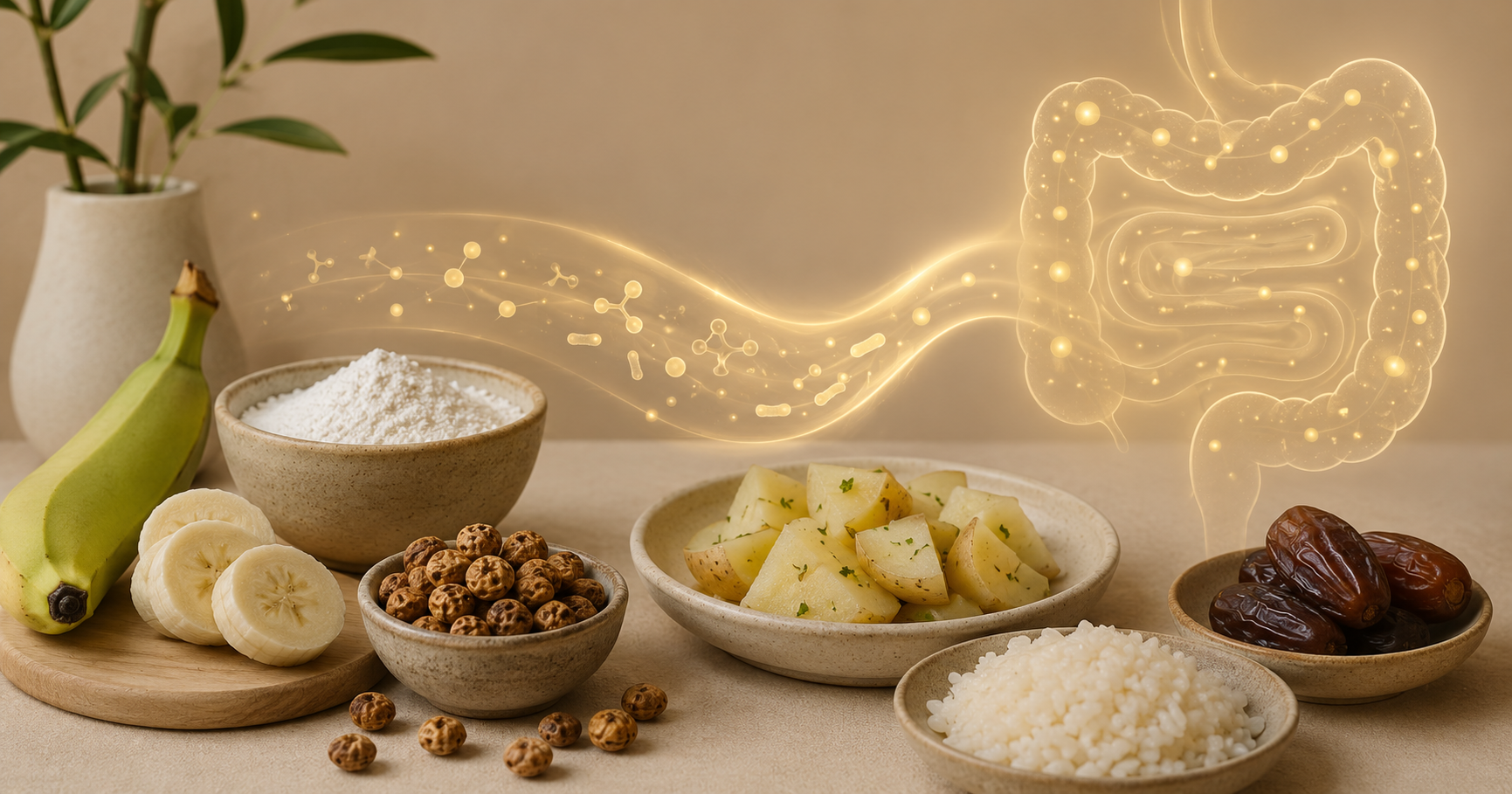
Resistant Starch Feeds Your Microbiome
Resistant starch follows a different route through the body. It feeds the microbiome, is partly converted into butyrate and provides fewer available calories. One GO100 bar contains 11 grams.
Read now