

Collagen
The body’s structural protein, also in the gastrointestinal tract
Collagen is the body’s most abundant protein and a central part of connective tissue. It is found in skin, bones, tendons, cartilage, blood vessels and organs but also throughout the wall of the gastrointestinal tract, where it is part of the structure that surrounds and supports cells.
In GO100, we use hydrolysed bovine collagen. It has an amino acid profile that differs from most other proteins and is particularly rich in glycine, proline and hydroxyproline.
Each GO100 contains approximately 7.5 grams of collagen, which contributes to the bar’s protein content, structure and full-bodied texture.
Frequently asked questions about collagen
What is collagen?
Collagen is not a single protein, but a family of closely related structural proteins. They form fibres and networks that give the body’s tissues strength and structure.
Different types of collagen occur in different parts of the body. What they have in common is a characteristic structure in which roughly every third amino acid is glycine, with proline and hydroxyproline also present in large amounts.
What function does the body’s collagen have in the gastrointestinal tract?
The collagen naturally present in the tissues of the gastrointestinal tract acts as a kind of internal reinforcement network. It is an important part of the extracellular matrix that surrounds cells and is also found in the basement membrane directly beneath the intestinal epithelium.
Collagen has several important roles:
- Provides strength and support: Collagen fibres contribute to the tensile strength of the intestinal wall and help the tissue withstand stretching and other mechanical stress.
- Contributes to a flexible tissue structure: Together with elastic fibres and other parts of the extracellular matrix, collagen helps the intestinal wall maintain its shape while changing volume and moving.
- Provides anchoring for the cells of the mucosa: Collagen is part of the basement membrane on which epithelial cells rest and attach. It forms a structural foundation for the boundary between the intestinal contents and the underlying tissue.
- Takes part in repair and remodelling: When tissue is damaged, parts of the existing support structure are broken down while new collagen is formed as part of the body’s repair and remodelling processes.
This describes what the collagen already present in the gastrointestinal tract does. It does not mean that collagen from food is transported unchanged to the intestinal wall, or that intake itself has been shown to repair it.
What makes collagen different from other proteins?
All proteins are made up of amino acids, but the amount and distribution of different amino acids vary.
Collagen stands out because of its high content of glycine, proline and hydroxyproline. Together, these make up a large proportion of collagen’s amino acids and give the protein its characteristic three-dimensional structure.
This profile clearly differs from proteins such as milk, egg and plant proteins. At the same time, collagen has a lower proportion of several essential amino acids and is therefore not used in the same way as a traditional protein designed to maximise essential amino acid content.
GO100 is not developed as a conventional protein bar. Collagen is instead part of a broader composition with resistant starch, MCT oil, glutamine and other carefully selected ingredients.
What is hydrolysed collagen?
Hydrolysed collagen is also known as collagen peptides. During hydrolysis, collagen’s long protein chains are broken down into smaller peptides.
This makes the collagen more water-soluble and easier to use in food. Unlike gelatin, hydrolysed collagen does not form the same jelly-like structure, but can be used in GO100 to contribute to a soft, cohesive and full-bodied texture.
What happens when you eat collagen?
Collagen does not move directly and unchanged from food to the body’s skin, joints or intestinal wall. Just like other proteins, it is first processed in the gastrointestinal tract.
Digestive enzymes break collagen down into free amino acids and smaller peptides that can be absorbed in the small intestine. Human studies show that both amino acids and certain hydroxyproline-containing collagen peptides can be found in the blood after intake of hydrolysed collagen. The body then determines how the absorbed components are used.
Is collagen naturally found in food?
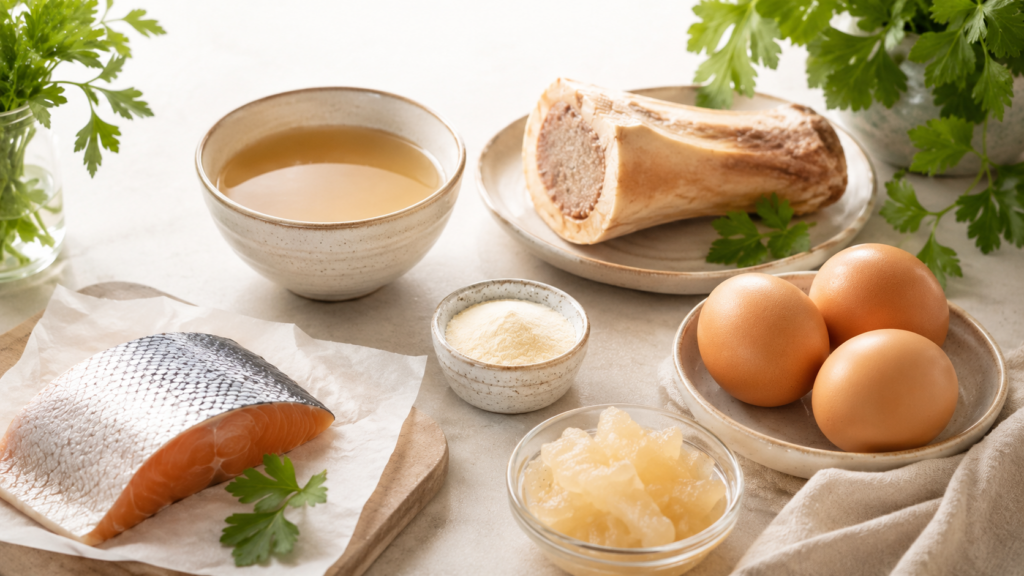
Yes. People who eat animal-based foods normally get collagen from parts that contain connective tissue, such as skin, tendons, cartilage and connective-tissue-rich cuts of meat. Gelatin is also made from collagen.
How much collagen a diet contains therefore depends on which parts of the animal are eaten. Lean muscle meat contains less collagen than, for example, slow-cooked meat, skin and connective-tissue-rich cuts.
Hydrolysed collagen comes from the same type of animal structural protein, but has been broken down into smaller peptides before being used in food.
Why does GO100 contain collagen?
We chose collagen because its properties suit GO100 in several ways.
It has a distinctive amino acid profile with high levels of glycine, proline and hydroxyproline. It is also a structural protein naturally found in connective tissue throughout the body, including in the different tissue layers of the gastrointestinal tract.
At the same time, hydrolysed collagen works well in the recipe itself. It contributes to the bar’s protein content, chewiness and full-bodied texture without turning it into a traditional protein bar.
How much collagen does GO100 contain?
Each GO100 contains approximately 7.5 grams of hydrolysed bovine collagen.
The collagen accounts for a large part of the bar’s total 9.6 grams of protein. This makes it easy to get collagen as part of a ready-to-eat food product, without having to mix a separate powder into food or drink.
Is GO100 a source of protein?
Yes. GO100 contains 9.6 grams of protein per bar and meets the EU conditions for being described as a source of protein. The condition is that at least 12% of the food’s energy value comes from protein.
For foods that meet this condition, the following authorised health claims may be used:
Protein contributes to the growth and maintenance of muscle mass.
Protein contributes to the maintenance of normal bones.
These claims apply to the product’s protein as a whole and do not mean that collagen specifically has an authorised effect on muscles or bones.
Where does the collagen in GO100 come from?
The collagen in GO100 is bovine, which means that it comes from cattle. It has been hydrolysed into smaller collagen peptides before being used in the recipe.
Because collagen is of animal origin, GO100 is not vegetarian or vegan.
A central part of GO100
Collagen is the body’s most abundant structural protein and is also found in the structures that make up the gastrointestinal tract. The collagen we eat is first processed by digestion and absorbed as amino acids and smaller peptides, which then become part of the body’s normal protein metabolism.
By combining approximately 7.5 grams of hydrolysed collagen per bar with resistant starch, MCT oil, glutamine and carefully selected ingredients, we have created a chocolate-coated premium bar with a composition that differs from both conventional snacks and traditional protein bars.
